Mill Creek History

Part 2: How Industrialization Shaped Mill Creek

by Rufaro Bulathsinghalage, Environmental Education AmeriCorps Member

Industrialization’s Impact on Mill Creek: 

Once the Miami, Shawnee and many other Native American tribes were removed from the region, and the waterway was renamed to be more fitting for industry, the Mill Creek changed rapidly and dramatically. The clearing of the Mill Creek Valley began in 1822 with the first two northernmost mills developed and installed in what we now know as West Chester. The novel “The Mill Creek–An Unusual History of an Urban Stream” by Stan Hadeen includes a quote from Lucy Braun–a deciduous forest ecologist. Braun writes that “nothing of the original vegetation of this part remains” and that “it is all farmland” in reference to the Upper Mill Creek Valley. The upland hillside forests were deforested into woodland pastures for livestock (cows, sheep, swine) to graze. The pigs were known to over-graze, constantly overturning the soil, destroying roots and timber in the process.


Decreases in Biodiversity:
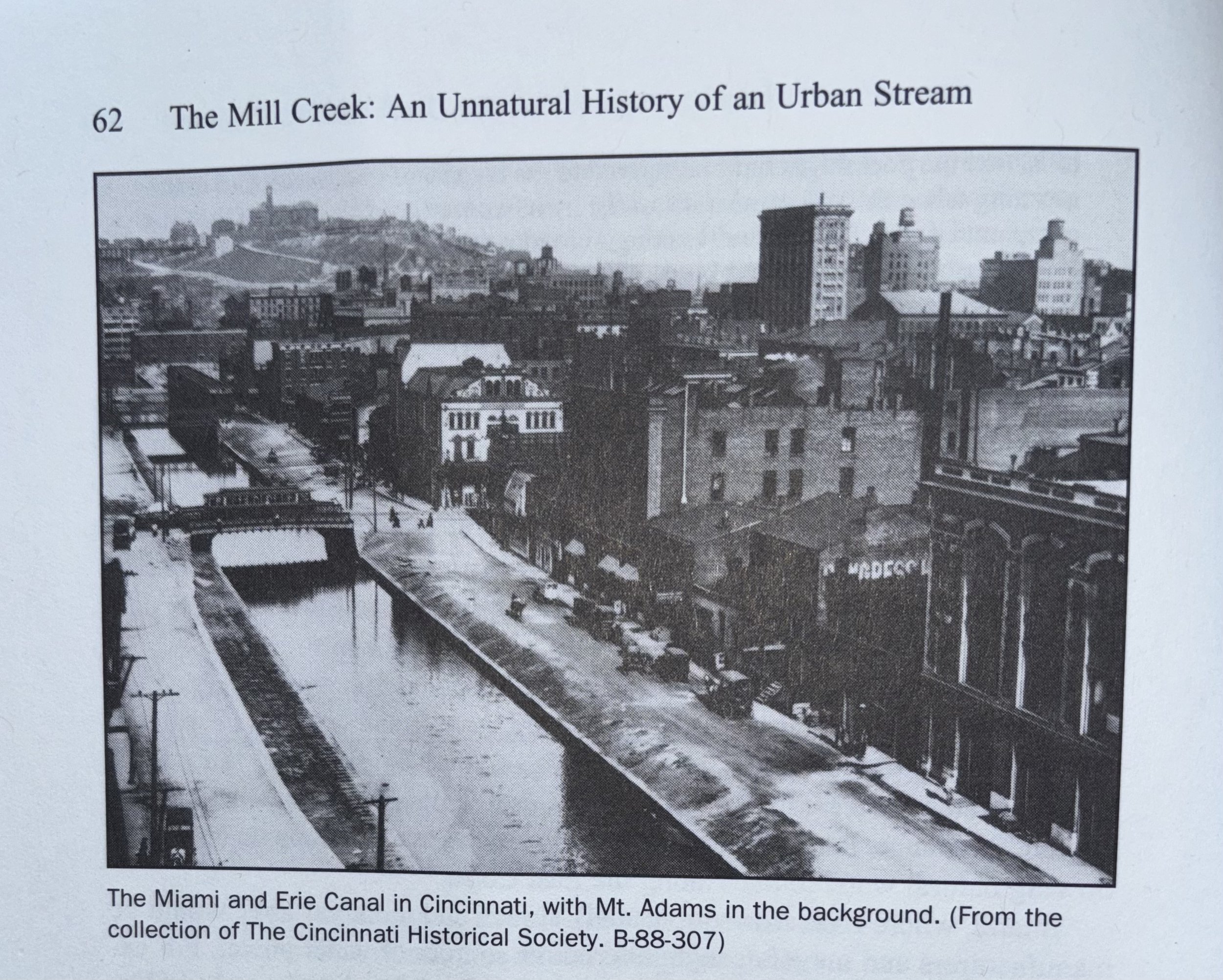
Maple, beech, and hickory trees were harvested for firewood while polar and walnut trees were chopped for lumber. The leather industry in Cincinnati boomed, resulting in a high demand for tan bark, so, all oak trees in a 75-100 mile radius were “ruthlessly slaughtered”. By 1881 deforestation had eliminated the woodlands in Hamilton County by 15%. 

Not only did the valley’s trees suffer, but so did its wildlife. Mammals such as the black bear, gray wolves, and mountain lions disappeared soon after their forested habitat was destroyed. Fish like the River Chub and the Darter vanished, likely a result of bottom-smothering sedimentation from the destruction of the watershed’s forest cover. Other fish populations became fatigued by over sedimentation of the waterway and likely suffered asphyxiation due to clogged gills, disruption of mating traditions as it became difficult for them to navigate the river, and overall habitat degradation. Macroinvertebrate species decreased and water quality levels plummeted–following was a decrease in their predators, further reducing biodiversity. Deforestation and the cultivation of farmland increased sediment load in the river, decreased animal biodiversity and increased the intensity of various parameters such as temperature, sunlight, nutrients, floods, and droughts. Woodland removal increased summer shoreline and streamwater temperatures, driving away thermally sensitive invertebrates and fish. (Ch. 2-3 in The Mill Creek: An Unnatural History of an Urban Stream by Stan Hadeen book)


Erosion and Flooding:

Deforestation does not go without its consequences–undisturbed forests experience soil erosion rates less than 50 tons/mi2/ year while cleared forests experience soil erosion rates upwards of 10 times that amount. Deforested watersheds are also susceptible to experiencing higher floods of shorter duration. This can be witnessed in the countless and devastating floods that occurred during the 1800s. 

1805: Caldwell’s mill in present-day Carthage was swept away in a flood that followed heavy rainfall. 

1808: A flood destroyed the first bridge built over Mill Creek.

1822: A 120-foot bridge constructed in 1816 was demolished by a flooded Mill Creek. 

(Ch. 2-3 in The Mill Creek: An Unnatural History of an Urban Stream by Stan Hadeen book)
As Cincinnati grew, so did its industry. During the Industrial Revolution, beginning in 1760, Cincinnati became an industrial powerhouse. Mill Creek was a vital resource in its growth, as it provided large, consistent flows of water, driving their machinery. Lockland, a watershed city, even installed a series of four locks that provided water to early factories. 

The lush, nutrient-rich floodplains of Mill Creek also attracted agricultural businesses. In the 19th century, many of Ciniannti’s plant and produce products were grown on nearby Mill Creek Valley fields. 

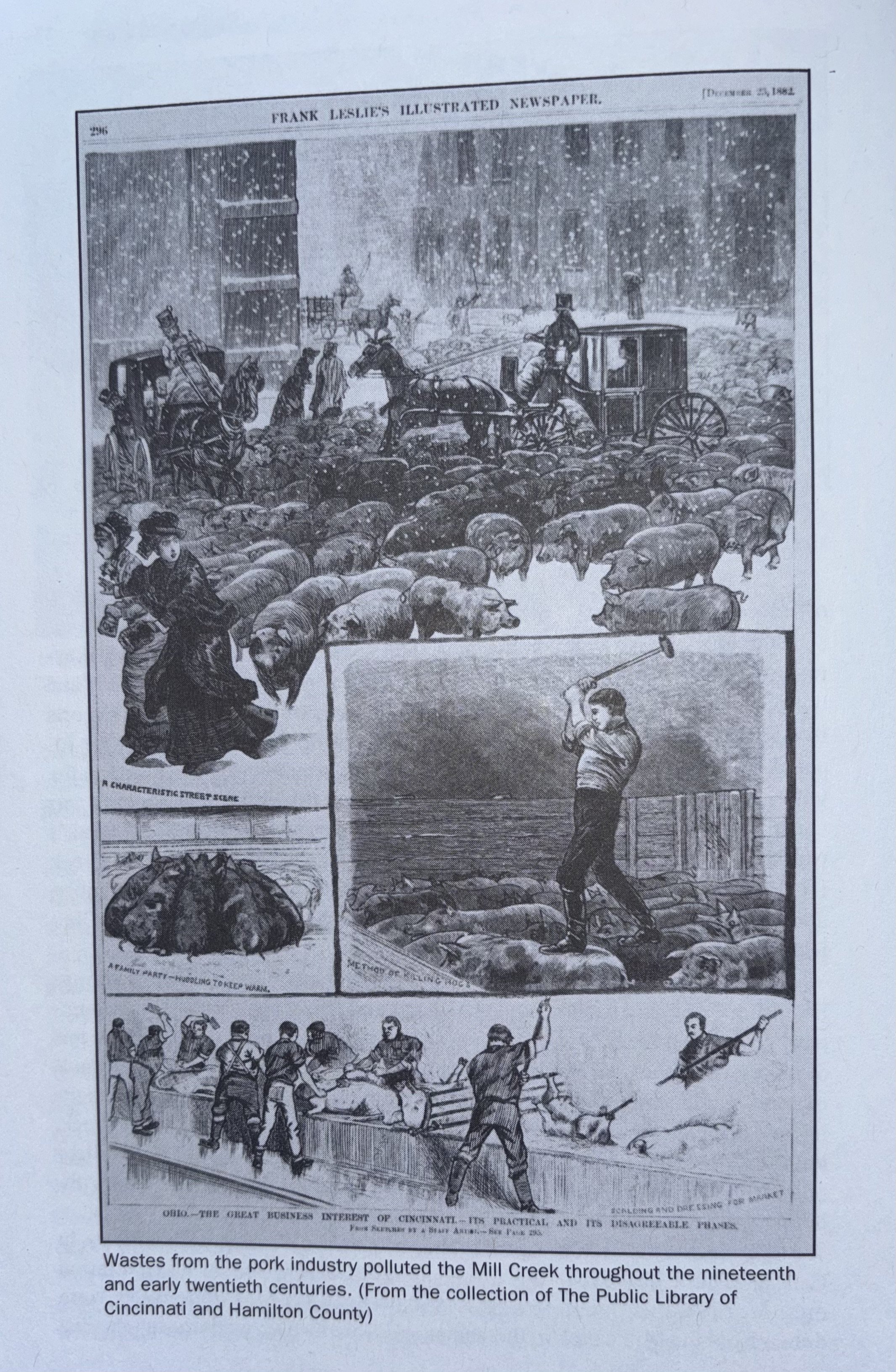
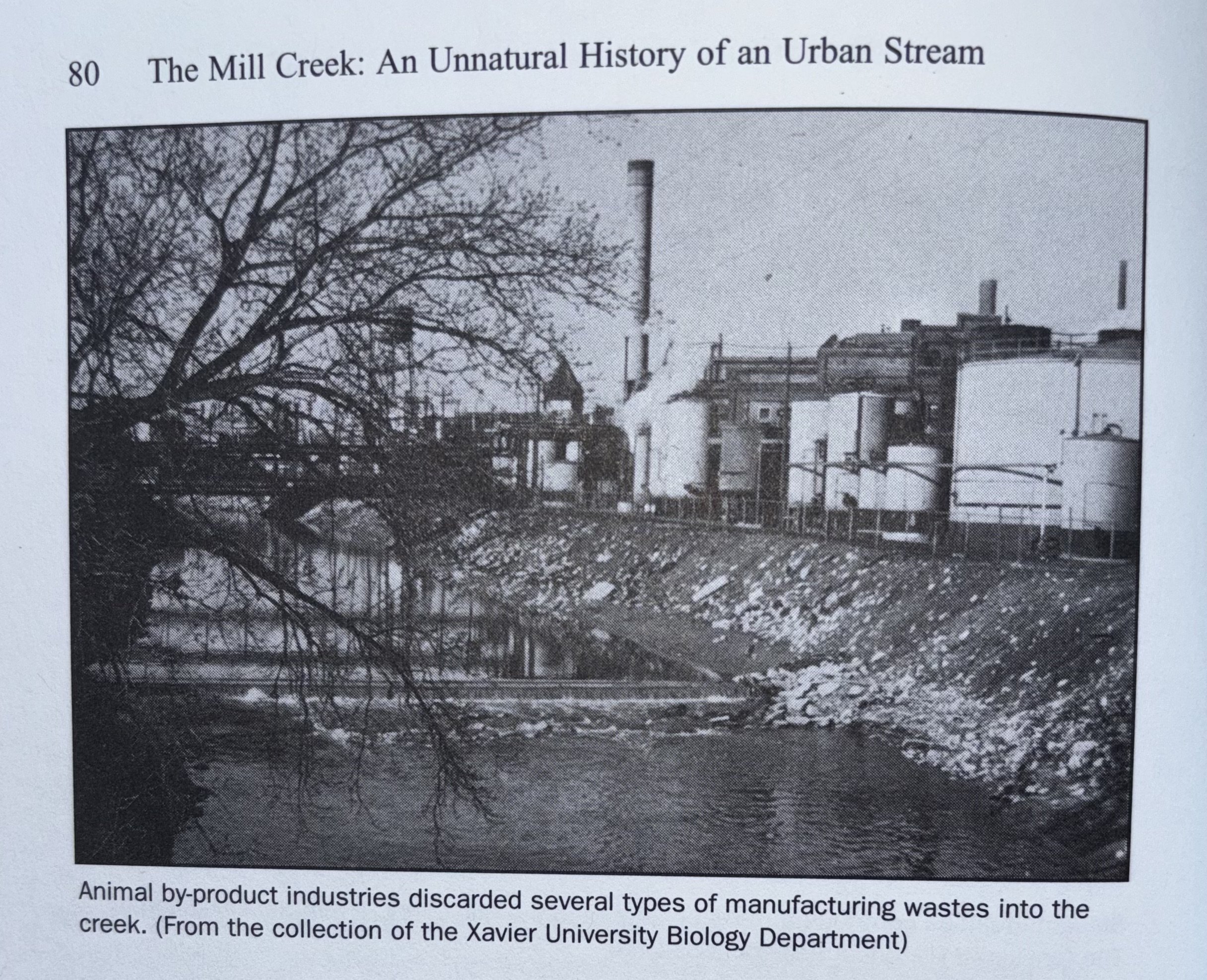
‘Porkopolis’ , is a potential catalyst for the devastating dumping that occurred in Mill Creek. Porkopolis was an extremely lucrative business in Cincinnati, however, like many things, it did not come without consequences, in this case–waste. By the early 20th century, Mill Creek waters were discolored by pig blood–a brownish-red effluent that even gave Mill Creek the nickname ‘Bloody Run’. Dairy  and other industries also contributed to what seemed to be endless dumping in Mill Creek. Drainage pipes from many of the city’s dairy industries dumped into Mill Creek, while the Mandery Pure Milk Company allowed its waste suds from churning and waste waters to flow down Mill Creek from upstream operations. The Walnut Hills Laundry Company drained roughly 20,000 gallons of wash water into a Mill Creek tributary and two of Locklands paper mills released about 3 million gallons of a “dark brownish black liquid containing much finely divided suspended matter” into the river–just to name a few. (Ch. 6-7 in The Mill Creek: An Unnatural History of an Urban Stream by Stan Hadeen book)
Nonetheless, the city continued to develop and over time one of the valley’s primary hazards continued–flooding. Flooding is something that the Mill Creek Valley had endured for hundreds of years; I even mentioned it when discussing the Native American history in the watershed. Not only were countless bridges destroyed by the floods that followed seasons of heavy rainfall, but the communities that surrounded the river constantly suffered the detrimental effects of severe flooding. In order to combat this, the U.S. The Army Corps of Engineers decided to channelize the river. Channelization is the process of straightening or redirecting natural streams in an artificially constructed stream bed. In theory, channelization has small benefits–it expands the area of fertile land in riparian zones (streambanks); in turn allowing for more efficient and productive farming practices. In the case of Mill Creek, however, channelization was overall a detrimental development of the waterway. In general, some of the drawbacks of channelization are that the channels provide the waterway with less volume to hold excess water during floods, it creates a steeper streambank leading to a faster flow of water running down the banks, which in turn increases erosion and over sedimentation of the waterway. Although the Army Corps of Engineers only met 40% of their goal, these are issues that we continue to combat today.  

I know that this seems to be a devastating story of how stewards of the land were pushed out of the Mill Creek Valley, just for its colonizers to develop and destroy the area, but after Mill Creek was named one of the most endangered rivers in North America by the American Rivers in 1997, community members and nonprofits began to shift the current. 

After 30 years of dedication, passion, and hard work, Mill Creek has been revitalized as a natural and community asset. With Education programs teaching the community about Mill Creek’s history, Restoration projects finding ways to mitigate the infrastructure that is damaging to the natural ecosystem, Recreation programs to re-connect people to the waterway, and a Water Quality Monitoring program that monitors the health and condition of the waterway–Mill Creek is making its resurgence one day at a time. 


Do not allow this story to create a negative image of the waterway and those who contributed to its detriment. Let this be a story of resilience, hope, and inspiration. Empowering you to connect with the river that may lie in your backyard and contribute to the movement that is restoring its vitality. Every step, no matter how small, plays a role in the healing process. The story of Mill Creek is a testament to what can happen when communities come together with a shared vision for restoration and conservation. It’s a reminder that even in the face of adversity, collective action can foster positive change. Now is the time to not only reflect on the past but to look forward to a future where Mill Creek, and waterways like it, thrive once again—nurtured by the very hands that once harmed them. Your involvement matters, and together, we can ensure that the river’s story continues to be one of revival and connection for generations to come.

PART 1: The Revitalization of Mill Creek and Its Native Roots

by Rufaro Bulathsinghalage, Environmental Education AmeriCorps Member


Introduction: 

The story of Mill Creek in southwest Ohio is one of both devastation and hope, shaped by indigenous stewardship, colonial expansion, industrialization, and environmental restoration. From the ancient presence of Native American tribes like the Miami and Shawnee to the unjust removal of these tribes through deceptive treaties, the land surrounding Mill Creek has witnessed significant transformation. As settlers renamed the Maketewah River to Mill Creek and began reshaping the valley for agricultural and industrial use, the waterway suffered severe degradation. But even as the river became a symbol of environmental harm, the community rallied for its revival. Today, Mill Creek is making a remarkable comeback through ongoing restoration efforts, education programs, and community-driven initiatives. Understanding this history is key to preserving Mill Creek and other local waterways.


Timeline of Native American History:

Native American history in the southwest Ohio region began with the Paleoindians (ca. 10,000–7500 BC), who settled along the Ohio and Miami Rivers, utilizing the land’s resources for food, water, and tools. The area's dense forests, described as ‘The Garden of Eden’, provided abundant wildlife and plants for sustenance. These early tribes practiced sustainable land and water management, ensuring the resilience of the ecosystem. As time progressed, the Archaic Culture (ca. 8000–1500 BC) emerged, with nomadic hunter-gatherer society developing early agricultural practices, including the ‘Three Sisters’ method of growing corn, beans, and squash together to improve soil fertility.

The Woodland Culture (ca. 1000 BC–1000 AD) marked an era of innovation, with the development of pottery and the construction of earthen mounds, like the Miamisburg Mound in Ohio, which offer insight into Native traditions. This period transitioned into the Fort Ancient Culture (Protohistoric period, post-AD 1400), where farming practices continued, particularly the cultivation of the Three Sisters. The Fort Ancient Culture influenced tribes in southwest Ohio and southeast Indiana, some of which evolved into historically documented groups as they entered the early recorded history period (SOURCE).


1750’s-60’s

The end of the French and Indian War marked the shift in rule of land in North America with the Treaty of Paris (1763). The Treaty of Paris relinquished French territories east of the Mississippi River to the English. As English settlers began to move further north, disagreements between English settlers and the Miami and Shawnee tribes arose. European settlers were attracted to the Mill Creek Valley because of the resources that it provided (such as fertile soil, navigable trails, food, shelter, and water power), however, the land was occupied by Native tribes. These tribes inhabited the Mill Creek Valley, but with the arrival of English settlers, they were forced to establish more watch points along the Ohio River, marking a boundary between tribal lands and settler encroachment. 


In 1763, the K5 Boundary established a boundary that prevented  English settlers from expanding west–England’s attempt at reserving land for Native American tribes (SOURCE). This was an attempt to reduce tensions between Native American tribes and English settlers, as England simply wanted to trade resources with Native Americans rather than further encroaching on Native American lands. English settlers did not respond well to this and felt as if England was treating them worse than it was treating Native Americans (SOURCE). As the American Revolution approached, English settlers may have used the Revolution to release their frustrations on Natives and the British Empire-further contributing to the violence erupting between settlers and Natives.


Ohio Removal:

The Ohio Removal occurred gradually through deceptive tactics, including unfair treaties negotiated by federal agents, intentional miscommunication by translators, and coercion of Natives under threat of violence. Notable treaties from this period include the Fort Stanwix Treaty (1784), Fort McIntosh Treaty (1785), and the Treaty of Greenville (1795), which allowed European settlers to claim Ohio for farmland, disregarding the Miami and Shawnee tribes who already inhabited the region. The culmination of these treaties led to the displacement of these tribes. Those who refused to relocate were simply no longer recognized as Native American people and the United States government would also refuse to record someone’s existence or intentionally misrecord their information (SOURCE). Following the Treaty of Greenville were various acts towards removing Miami and Shawnee tribes west of the Mississippi River. 

July of 1803: President Thomas Jeferson gives the first official proposal for the removal of Natives. His rationale was that Natives would be free from further white interference and would never be displaced from their home again. 

January 1825: President James Moore presented a definite removal policy to Congress.  

1829: President Andrew Jackson dedicated himself to relocating eastern Natives west of the Mississippi River. 

May 1830: The Indian Removal Bill was passed and it provided President Jackson with the authority to forcefully displace Native people. 

As a result, Miami, Shawnee and many other Native tribes in Ohio, Indiana, and Illinois unwillingly relinquished most of their land, maintaining small reserves. The Wyandot Tribe relinquished 4.5 million acres of land in Indiana, and the Miami tribe relinquished 6.7 million and 297,000 acres of land in Indiana and Ohio respectively (SOURCE). When the United States finally won its independence from England, there was motivation to begin clearing the land in the Midwest. In turn, thousands of Natives were forced to relocate to the lands beyond the Mississippi River. 


Renaming of the Maketewah River:

Once the Miami, Shawnee, and other Native tribes were removed from the southwest Ohio and southeast Indiana regions, American settlers were steadfast and eager with clearing the land and developing it to be suitable for eastern settlers. In order to make the Mill Creek Valley suitable for settlers, some changes were made. The most notable being the renaming of what Natives formerly called the “Maketewa River” to what we now know as the “Mill Creek”. The word "Maketewa" likely translates to "it is black" or "it is dark," and the Mill Creek Valley was historically abundant with Black Walnut trees (Juglans nigra). The walnuts from these trees contain a polymer called lignin, which, when exposed to water, undergoes a chemical reaction that turns the water a dark brown or black. This suggests that the dark color of the water may be linked to the presence of black walnut trees. 

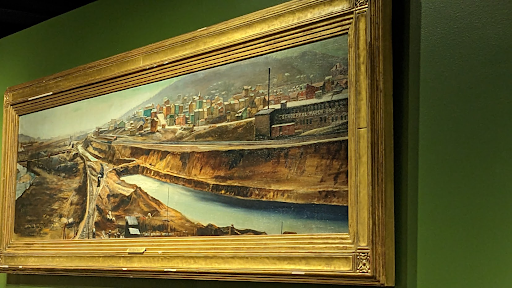
The renaming of the Creek began with John Cleves Symmes, a congressman from New Jersey with an interest in western colonization. Symmes took a trip to the “Ohio country” in 1787 and followed up his visit with a contract with the U.S. Treasury Board for his Miami Purchase. His purchase included a region east of the Great Miami, the region known as the Maketewa watershed. Symmes released various notices, asking for permission to purchase and develop the land, and in doing so he changed the name of the river from the “Maketewa River” to the “Mill Creek”, in doing so, he created a subtle marketing message that encouraged the development of industry along the waterway. (Ch. 1 of Stan Hadeen Book) This painting is on display at the Cincinnati Museum Center (CMC). It is displayed at the CMC Objects and Fine Art Collection and it showcases the western hills and Mill Creek alongside them. The portrait originates from the early 19th century and is the “B&O Railroad-Millcreek Exchange” looking South from Hopple Street. 

As I researched the rich history that lies within the Mill Creek Valley, I found myself going down many rabbit holes—uncovering more and more about the development of the city. In need of a break, I decided to retreat to the Norwood Mound, located in Norwood, Cincinnati. This mound, rumored to be a former watchpoint, overlooks the southeast cities of Cincinnati and offers a sweeping view of the Ohio River. Standing there, I couldn't help but reflect on the land’s deep connection to the Miami and Shawnee tribes who once called this region home along with many others. 

For now, I leave you with this moment of reflection.

Join me next week as I continue to delve deeper into the fascinating history of Mill Creek, uncovering the stories of those who shaped its past and the efforts that are helping to restore it today.